Advancing Research on Brain Health in Sport
Published27 January, 2026
Photo credit Patrick Leung
A federal research grant gives CapU kinesiology students hands-on experience that goes beyond the classroom and demonstrates the impact of applied research.
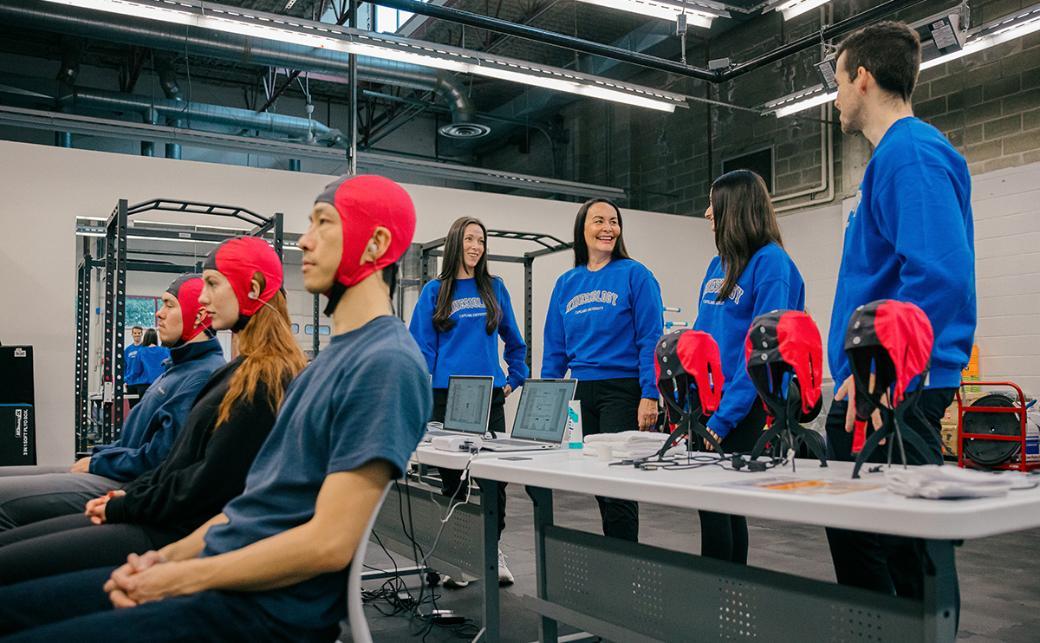
Repetitive head impacts (RHIs) – minor but repeated blows or jolts to the head – are an underrecognized risk in contact sports. Unlike concussions, which often receive immediate medical attention, RHIs can accumulate silently over time, potentially leading to long-term cognitive and mental health issues.
Studies show that a significant percentage of junior hockey players experience RHIs during a season, highlighting the urgent need for research and prevention strategies.

“Through the RESILIENCE Project, we’re breaking new ground by studying brain function, resilience, and mental health in hockey players across an entire season,” says Perry.
“This research is vital for further understanding athlete safety and recovery – and thanks to NSERC funding, our students gain hands-on experience with cutting-edge EEG technology, preparing them for careers in sport science and health.”
For kinesiology students, the impact is immediate.
“Seeing the NeuroCatch device come to CapU and being part of the RESILIENCE Project has been such a wonderful experience,” says student research assistant Chelsea Watson.
“It’s incredibly meaningful to work on a project rooted in passion and to bring awareness to athletes about brain health. These hands-on opportunities go beyond the classroom and remind me how impactful applied research can be.”
CapU is the first post-secondary institution in B.C. to gain access to this portable “brain lab,” specifically designed for applied research and point-of-care assessment.
The technology provides immediate reports on three critical brain responses – auditory sensation, basic attention and cognitive processing – within seconds of a six-minute cognitive test.


Research in action
Hands-on opportunities go beyond the classroom in preparing kinesiology students for careers in sport science and health.
Bachelor of KinesiologyThe researchers are exploring resilience in young athletes using these EEG-based assessments, along with surveys, to better understand mental health, well-being and brain function in high-contact sports.
The ARTI grant builds on momentum from a $1.7-million NSERC Mobilize grant awarded to CapU in 2023 to support research partnerships.
With federal support and state-of-the-art technology, CapU students and faculty are contributing to the future of brain health research in sport – one brainwave at a time.