Leading in ECCE: From Student to Teacher
Published8 January, 2026
Photo credit Patrick Leung
What happens when a classroom becomes a living, creative playground? CapU ECCE student-turned-teacher Isabel Porter is helping to shape the next generation of learners right here.
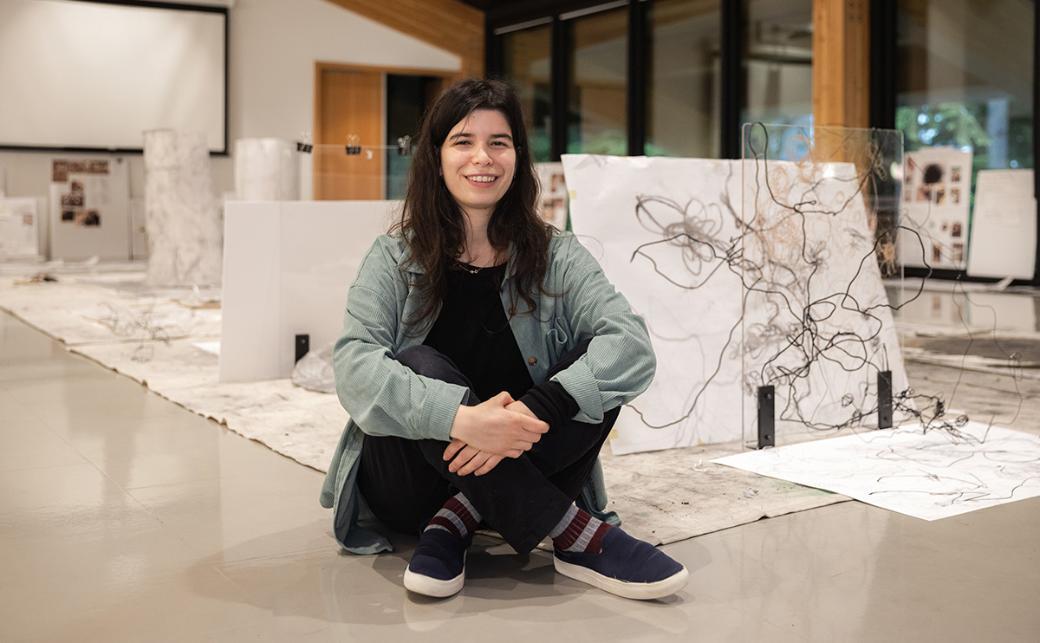
For Isabel Porter, the journey from student to educator at CapU has been as creative as the classroom she now teaches in.
Starting in the Bachelor of Early Childhood Care & Education (ECCE) Degree program, she was inspired by educators who challenged her to think in new ways about childhood, care and learning.


“The ECCE program at CapU is a really rich one,” she says. “There are so many amazing teachers, and the program really pushes you to think in different ways. I hope my teaching and research reflect the pedagogical and ethical commitments I developed there.”
Now, as part of her final research project while being employed as a teacher at the Fulmer Family Centre for Childhood Studies, Isabel explores creativity as a living, relational ecology.
“In our classroom, ideas bounce from person to person and change as they go. One action inspires another, and everything in the space – people, materials, the classroom itself – interacts to create the moment.”
The research project focuses on the vital role art plays in our daily collective lives and how it can serve as a means of understanding and connecting with the world.
“I love an idea from research-creation that considers creativity an ecology, alive and made up of everything and everyone present in that moment. It’s a compelling idea because it highlights relationality. I’m thankful to have the space to think more deeply about this.”
Isabel is also inspired by her students. “I don’t believe that children are more creative than adults. But I do think children tend to be more fluid in their creative responses, more open to experimenting in ways that are harder for adults to do,” she explains.
“For example, jumping from medium to medium, or shifting ideas in surprising ways without the need for a ‘good’ or clear reason. An impulse to try it out is reason enough.”
When Isabel spends time thinking with children, she says she is given the chance to practice and make her own responses more fluid, experimental and improvisational.
She describes creativity as something to share and engage in together, paying attention to how the classroom is already a creative ecology.
“The materials and how the classroom is composed also affect our actions. Everything is at play, each element acting on the other to create the moment.”


While her project is small, she hopes to deepen her own understanding of creativity and explore what’s possible in early learning settings alongside children and other educators.
“Beyond that, if my project were to slightly shift another educator’s ideas about the role of art in ECCE or make someone consider creativity as relational, that would be delightful.”
“It might be obvious to say, but what I love most is spending time with children, getting to know them and their families. The children are the greatest gift! I also love working alongside such committed, thoughtful, creative and generous educators. This work is beautiful and difficult, and the people you work with make an enormous difference.”
For Isabel, every day is an opportunity to learn, create and grow alongside children and colleagues alike. It’s this blend of curiosity, collaboration and care that makes teaching at CapU so rewarding.
Related