
Building Bridges: CapU x Langara research exchange forges connections, paving way for future collaborations
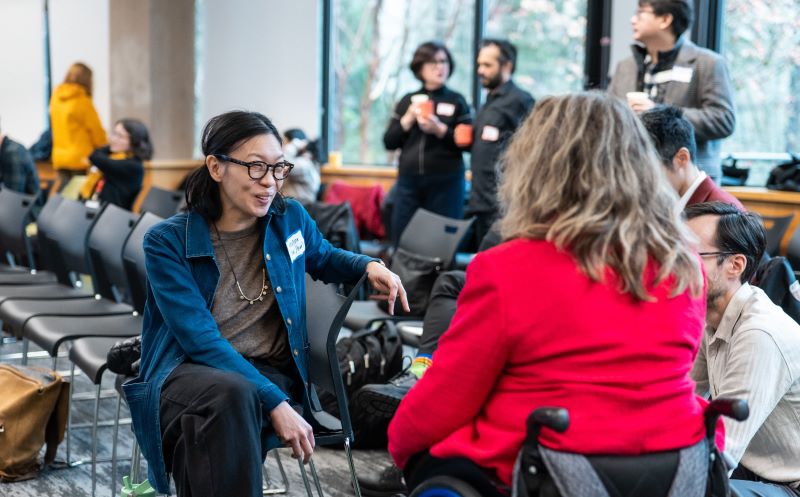
Capilano University (CapU) and Langara College came together Nov. 21 for the second annual research exchange, a collaborative event designed to spark innovation and strengthen applied research partnerships between the two institutions.
Funding for the series came from each institution’s Natural Sciences and Engineering Research Council of Canada (NSERC) Mobilize grants.
The event—hosted by CapU’s office of Creative Activity, Research and Scholarship (CARS)—was open to everyone interested in applied research and knowledge exchange. It was attended by 60 employees and students from both institutions, underscoring the strong commitment to collaboration across campuses.
“Events like this are about building connections,” said Andrea Heaney, project manager (NSERC), CARS. “They allow faculty to share ideas that are in progress, explore collaborations and transform emerging concepts into funded, impactful projects.”
This marks the second annual research exchange. Last year’s event was hosted by Langara’s Applied Research Centre.
The exchange builds on a memorandum of understanding (MOU) signed by both institutions in early 2023. A key component of the MOU is fostering joint research initiatives and shared mobilization events—creating opportunities for faculty to connect, collaborate and amplify the impact of their work.
The event introduced participants to the Building Bridges Community Connection Grant, a joint funding program supported by federal NSERC Mobilize grants awarded to both institutions. The program was created to catalyze collaboration by providing resources for faculty-led projects that address community needs through applied research.
This year’s keynote showcased the successful project from last year’s grant competition: “Writing Lives,” led by Langara faculty Jill Goldberg and CapU faculty Fenn Stewart. Developed by Langara in 2019, the Writing Lives program bridges generations by bringing students and Indigenous Elders together to co-write life stories, fostering cultural understanding and reconciliation to bring attention to the history of Indian Residential Schools. CapU plans to offer the program next year.
The keynote was followed by a pitch session, where faculty from disciplines spanning health care, media and design, environmental science and emerging technologies showcased early-stage projects—some leveraging innovative tools such as drones and acoustic sensing.
The event provided a forum for feedback, insights and potential partnerships, reflecting the breadth and strength of applied research at both institutions, Heaney said. “A special thank-you to the federal research agency NSERC for their funding support through the Mobilize grant, which makes opportunities like this possible.”
Submitted by: Communications