Capilano University celebrates opening of first on-campus student housing at North Vancouver campus
News release: CapU opens first on-campus student housing at North Vancouver campus (PDF)
NORTH VANCOUVER, B.C. June 29, 2026—Today, Capilano University (CapU) celebrates the official opening of the first on-campus student housing building at its North Vancouver campus.
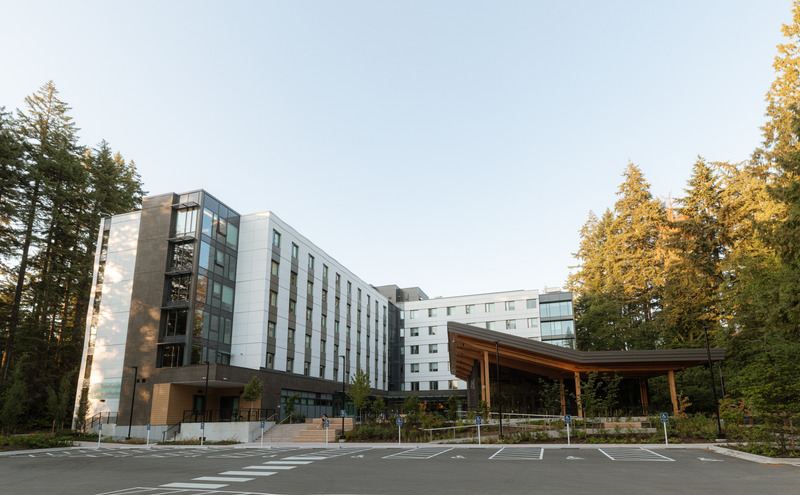
The new building, Treehouse (Lam̓íwa / θqétəw̓txʷ), marks a significant milestone in CapU’s evolution, supporting student success by providing safe, conveniently located, below-market housing and fostering a connected campus community.
Lam̓íwa and θqétəw̓txʷ, both translating to “Treehouse,” were provided by the Sḵwx̱wú7mesh Úxwumixw (Squamish Nation) and the səlilwətaɬ (Tsleil-Waututh Nation), respectively, reflecting a vision of “a home in the woods.”
The new student housing and dining hall building will accommodate 360 students, along with a two-bedroom suite for a residence life facilitator. Initial student move-in began May 30, with full occupancy expected in September 2026.
“Home is more than a place. It’s where dreams take root, resilience grows and futures begin. With the opening of Treehouse on our North Vancouver campus, we thank the Province for helping us create a campus community where students have safe, affordable housing, and a space to learn and thrive,” said President Jason Dewling.
The project was made possible through a partnership with the Province of British Columbia, including $41.5 million in provincial funding toward the $58.2‑million total project budget.
“For many post-secondary students, having a place to live on campus can make all the difference,” said Bowinn Ma, Minister of Infrastructure. “This new student housing at Capilano University will give students a supportive place to live, study and build community, while making it easier for them to access the education and opportunities they came here to pursue.”
The building responds to strong demand for student housing in the region, where many CapU students have traditionally faced long commutes and limited rental options.
“After two years of commuting three hours a day, moving into student housing changed my university experience,” said Manroop Kaur, a CapU student. “Treehouse means more students can have that same opportunity right on campus—closer to class, closer to community and better able to succeed. It’s not just a place to live; it’s a place where you belong.”
Designed to support both academic success and student life, the six-storey, 8,250-square-metre building includes a café and 250-seat dining hall open to the community during regular operating hours. Each floor features shared study spaces, lounges, kitchens and single-user washrooms with showers, alongside a mix of single and double rooms, including accessible units. The building also includes student support spaces, a multipurpose room and an Indigenous-focused reflection space.
The building incorporates mass timber construction and is designed to exceed current B.C. Building Code energy-efficiency standards. It targets LEED Gold equivalency and will meet Step 4 of the BC Energy Step Code.
Learn more at capilanou.ca/student-services/student-housing.
About Capilano University
Capilano University offers students a remarkable space to thrive with industry-leading instructors, small classes and more than 100 programs across five distinctive faculties. Serving British Columbia’s North Shore and Sea-to-Sky regions with locations in North Vancouver and Squamish, CapU is a unique space where students are encouraged to make their mark, in and out of the classroom. We respectfully acknowledge that our campuses are located on the unceded territories of the səlilwətaɬ (Tsleil-Waututh), Skwxwú7mesh (Squamish) and xʷməθkʷəỷəm (Musqueam) Nations.
For more information, or to schedule interviews, please contact:
Layne Christensen
Senior Communications & Government Relations Officer
Capilano University
t: 604 220 8937
e: laynechristensen@capilanou.ca
capilanou.ca
Submitted by: Communications & Government Relations